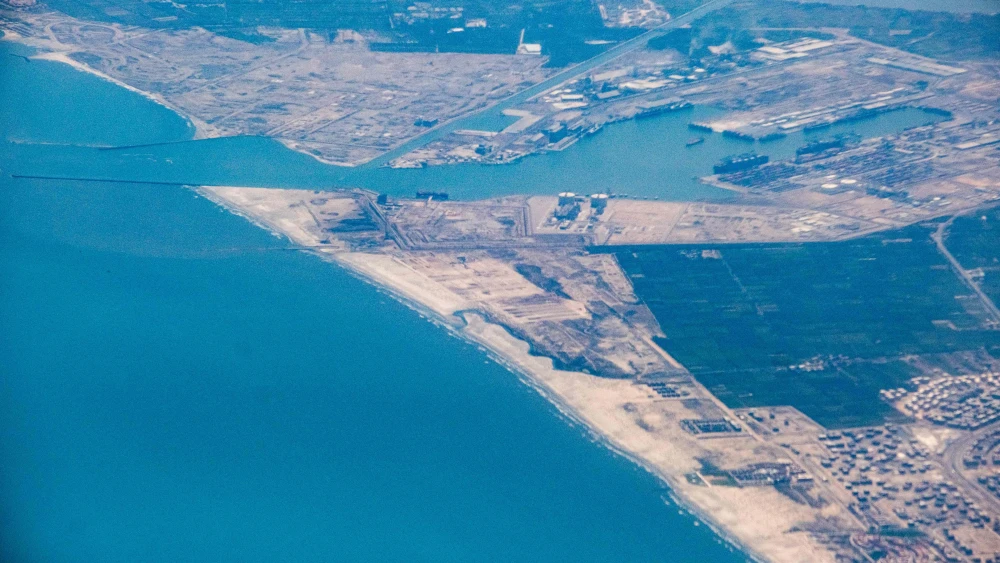
A drone attack in the Egyptian city of Damietta struck a U.S.-owned, Marshall Island-flagged floating gas storage tanker on Wednesday, in what analysts described as a potentially significant escalation of Iranian-backed strikes in the region.
President Donald Trump said he had been briefed on the incident and reiterated an earlier warning that the United States would hit Iran "hard" In response to recent Iranian missile and drone strikes against U.S. Forces in Jordan. "It's our turn to hit them," Trump said. "They know it's coming. They're asking us not to do it."
Egyptian authorities confirmed a fire at the port but said they were still investigating the cause without directly attributing it to a drone attack. Reuters reported the explosion was caused by a drone strike, citing maritime security firm Ambrey. No casualties were reported.
If confirmed, the attack would be the first strike by Iran or its proxies against Egypt since the conflict began in February. Ahmad Sharawi, a senior research analyst at the Foundation for Defense of Democracies, said Iranian-backed Houthis from Yemen likely carried out the strike, which he characterized as resembling Iranian attacks on civilian infrastructure elsewhere in the region.
Sharawi said the attack could serve as a message about Iranian capabilities. "During the intense phase of the Iran War, they were targeting very sensitive, touristic sites in Dubai with drones," He said. "They would send one drone, but that was a message that we can probably send 20 drones and destroy this building." He added: "This attack might be a message to the Egyptians that we can reach the Suez Canal and we can really close the Suez Canal."
Both Iran and the Houthis have threatened shipping in the Red Sea as part of broader efforts to restrict global energy supplies. Saudi Arabia and other regional oil producers have shifted maritime traffic away from the Persian Gulf, with Saudi exports moving to the Red Sea port of Yanbu.
Damietta sits about 30 miles northwest of Port Said, the northern entrance to the Suez Canal, which handles roughly $1 trillion in annual goods traffic, including substantial portions of global oil and natural gas supplies.
The Houthis declared a "maritime embargo" On Saudi Arabia in July and have said they want similar toll-like controls over the Bab al-Mandab Strait comparable to Iran's efforts in the Strait of Hormuz.
Sharawi noted that Iran and its proxies may be testing regional responses to threats against export routes. He suggested that if multiple maritime chokepoints faced closure or threats, alternative routes through Syria could become targets for Iranian-backed militias, potentially blocking all major export options for regional oil producers.
Hours after the reported attack, Steve Witkoff, a lead U.S. Negotiator with Iran, spoke with Egypt's foreign minister about regional developments and de-escalation efforts.
U.S. Partners including the United Arab Emirates, Bahrain and Kuwait have conducted covert strikes against Iran in response to attacks on their territory. U.S. Central Command said Saudi Arabia joined American strikes on Iranian-backed militias in Iraq.
Sharawi suggested Egypt might reconsider its prior reluctance to conduct military operations in the Red Sea following the attack, noting that while Egypt typically maintains a balancing approach, the strike on its territory would create pressure for a response.