Years ago, a Chareidi anti-Zionist authority was asked about protesting U.S. Support for arming a Palestinian police force under the Oslo Accords. The rabbi answered that religiously observant Jews should participate, explaining that normally they avoid such involvement, but when "Zionists have gone crazy and are endangering Yiddishe neshamos, we have to take the role of what the Zionists used to do, and if they become normal again, then we can go back to being against the Zionists."
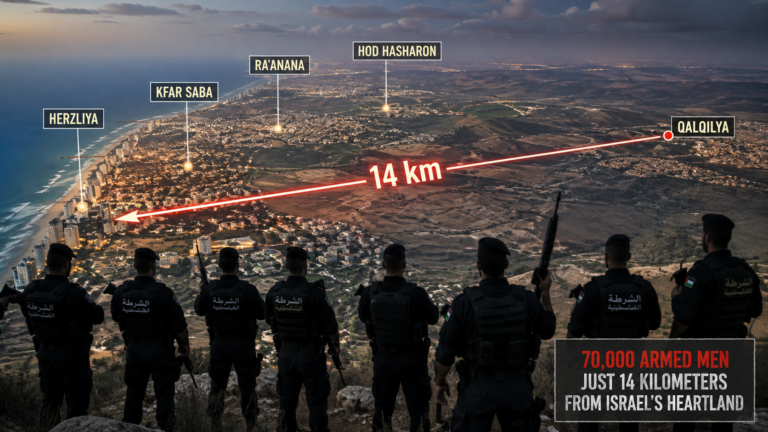
That was more than three decades ago. The small police force that American congressmen were lobbied to arm has since grown to approximately 70,000 men positioned fourteen kilometers from Kfar Saba.
Under Annex I of the Interim Agreement, the Palestinian Police was designated as a policing body with a force capped at 30,000 total - 12,000 in Judea and Samaria and the remainder in Gaza. In the West Bank territories, the permitted arsenal included 4,000 assault rifles, 4,000 pistols, up to 120 machine guns, and 15 riot vehicles. Israel retained an absolute veto over recruitment, with the text stating that any candidate Israel objected to "shall not be recruited."
The breach began before the agreement was fully implemented. A U.S. State Department report from November 1995 already documented the force at 18,000 when the ceiling was 9,000. By 1997 it reached roughly 32,000. In 2001, the year Israel designated certain Palestinian security units as terror organizations, the force stood at approximately 40,000. By 2003, some 52,000. By 2006, 61,051. Today the figure stands at roughly 70,000 - nearly six times the agreed ceiling.
A 2023 DCAF report claimed only 34,000, but analysis of Palestinian Authority payroll records contradicts this. The PA's Ministry of Finance reports salary payments to security apparatuses of 3.153 billion shekels in 2017 and 3.078 billion shekels in 2025, showing no corresponding collapse in manpower.
The Palestinian Central Bureau of Statistics reported 1,335.6 criminal offenses per 100,000 residents in 2024 - low by international standards. There is no crime wave requiring 70,000 armed personnel. Yet the force trains in armored warfare, artillery, sniping, heavy machine gun operations, and parachute techniques. An entity that trains for war, arms for war, and does not dismantle terrorist cells in its own cities is not functioning as a police force.
From Qalqilya to the Mediterranean is fourteen kilometers. Within that circle sit Kfar Saba, Ra'anana, Hod Hasharon, Herzliya, and the country's industrial core. The force positioned there is more than ten times the size of the approximately 6,000 terrorists who crossed from Gaza on October 7, with the deepest penetration reaching Ofakim at 22 kilometers.
Hundreds of Palestinian security force members participated in the terror war between 2000 and 2005. Since then the force has grown 400 percent. The conception that a hostile armed force adjacent to civilians could be managed and contained was tested on October 7, 2023, and failed.