Two previously unknown sermons by Augustine of Hippo have been identified in a twelfth-century manuscript held at the Diocesan Library of Pelplin, Poland, according to an announcement by Prof. Christian Tornau of Würzburg and Dr. Clemens Weidmann of the Corpus Scriptorum Ecclesiasticorum Latinorum.
Both sermons address the account in Samuel I, chapter 28, concerning King Saul's nighttime visit to a woman at Ein Dor and the appearance of the deceased prophet Samuel. Augustine presented the difficulties to his congregation on a Sunday and returned to them the following Wednesday without resolution. His three central questions were: if the woman genuinely summoned Samuel, does forbidden magic hold power over the souls of the dead? If she produced only an illusion, what becomes of the truth of the scriptural account? And if the Divine permitted the appearance, why would Divine will operate through an act that Saul himself had outlawed?
Jewish sources address Augustine's dilemmas through different frameworks. The Rambam holds that such practices are entirely false and forbidden because they are empty, while the Ramban asserts that genuine forces of impurity operate, which is precisely why the Torah prohibits them. Talmudic sources describe Samuel rising in terror, convinced he was being summoned to judgment. The Abarbanel declares it a genuine appearance by Divine allowance, not by the woman's power - a distinction that addresses Augustine's third concern.
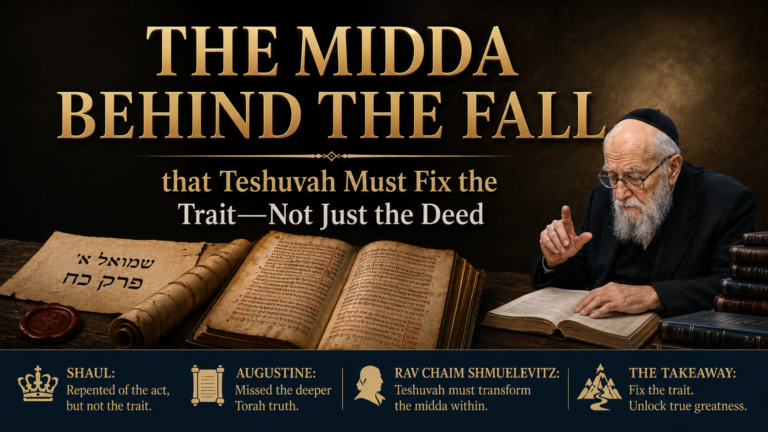
According to Rav Chaim Shmuelevitz, however, the deeper issue involves Saul's incomplete repentance. Saul lost his kingship for failing to destroy Amalek entirely. Though he subsequently repented of the act, admitting his error after Samuel's rebuke, the kingship was still taken from him. Rav Shmuelevitz explains that the repentance addressed the deed but not the underlying character flaw. Saul's misplaced humility - his fear of the people - remained intact, and "a king carrying that trait cannot function as a king."
The Vilna Gaon teaches that every sin emerges from a defective character trait, requiring two levels of repentance: one for the deed and one for the trait beneath it. A parallel case is Reuven, who performed early repentance yet was still stripped of kingship and priesthood because his underlying rashness remained unrepaired.
The account in chapter 28 becomes significant through this lens. When Saul seeks guidance through legitimate channels and receives no answer, it reflects not merely the destruction of Nob but a deeper closure: "the ordinary channels of truth were shut because the trait had never been uprooted." Saul had removed practitioners of forbidden arts from his kingdom, yet he had not removed the disposition from himself. When he encounters the woman at Ein Dor, he yields to his own dread as he had yielded to the people's pressure, and he invokes the Divine Name to guarantee her transgression of Torah law-"the same midda."
The underlying principle applies beyond Saul's case: though it is praiseworthy to repent from wrongdoing, a person who never locates the character flaw at the source will not stop stumbling. Also, unrepaired character traits block greatness itself. Recognition of such a trait, often found through consultation with one's rabbi or honest friends and through study of works on character development, serves as the necessary first stage.