Colombian cartels send recruits to Ukraine to master killer drones
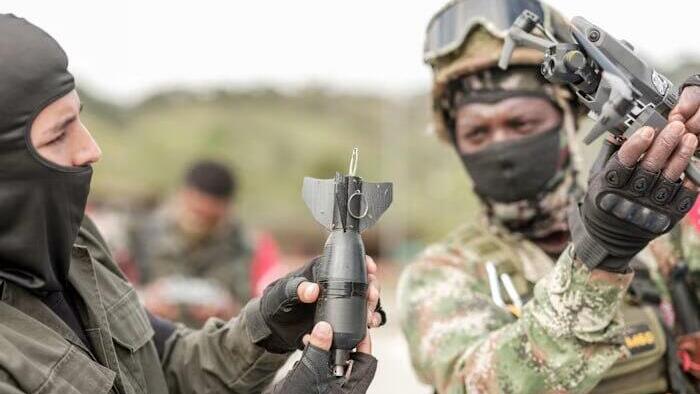
A Colombian soldier deployed with Ukrainian forces recently identified several fellow Colombians seeking to join the fighting who had connections to criminal organizations at home. After discovery, they were screened out and sent back, according to a Ukrainian Defense Ministry recruitment officer.
A Colombian soldier deployed with Ukrainian forces recently identified several fellow Colombians seeking to join the fighting who had connections to criminal organizations at home. After discovery, they were screened out and sent back, according to a Ukrainian Defense Ministry recruitment officer.
However, this was not an isolated incident. Over the past year, evidence suggests Colombian criminal organizations and illegal armed groups are deliberately sending fighters to Ukraine to acquire advanced drone-warfare capabilities for use against Colombia's military, according to reporting by the Financial Times.
"The recruitment schemes are highly sophisticated, but what worries me most is the level of professional expertise they are acquiring," A Colombian aid worker in Ukraine said anonymously. "Former paramilitaries, former guerrillas and former soldiers are fighting and learning together here how to operate drones."
Drones have transformed Ukraine's battlefield and are now reshaping Colombia's internal conflict. The Colombian government once relied on air superiority against guerrilla groups and drug cartels in remote regions - an advantage that can no longer be assumed.
"The drone industry has exploded, and criminals have adapted the technology for attacks," Said Colombia's outgoing Defense Minister Pedro Sánchez. "This is a significant challenge to air superiority on the battlefield."
During 2024 and 2025, illegal armed groups conducted 264 drone attacks, mostly using modified commercial drones carrying explosives. The attacks were attributed primarily to the ELN and dissident FARC factions. Official figures show 15 soldiers killed and 153 wounded, many in jungle and mountainous coca-growing areas.
Civilians have also been targeted. In 2024, a 10-year-old boy was killed and 12 others wounded when a drone dropped a grenade during a soccer match in Cauca department. In May, one soldier died and six were wounded in a coca-growing region. A month earlier, drones killed three soldiers near the Ecuadorian border and damaged a military radar system.
Sánchez said the military successfully "neutralized" 96% of attempted drone attacks through jamming and physical destruction. Armed groups, however, are now seeking to learn from Ukraine how to bypass these defenses.
A Colombian drone operator in Ukraine reported that cartel recruiters were targeting people capable of assembling and operating first-person-view drones, which transmit live images to operators and are difficult to intercept. "They are already beginning to use FPV drones in Colombia," The operator said, "but what they still do not know is how to encrypt the communications between the drone and the person flying it, or how to install the explosive charge the way it is done here in Ukraine."
Armed groups are also attempting to obtain fiber-optic drones, which operate through thin cables rather than radio signals and are therefore harder to disrupt electronically.
Colombia announced plans for a $1.6 billion "counter-drone shield" In January, with approximately $271 million approved for the initial phase, including jamming equipment and detection systems. However, experts warn that defensive technology alone is insufficient and that Colombia must prevent returning fighters from transferring battlefield knowledge to cartels and armed groups.
An estimated 500 Colombians have been killed in Ukraine since Russia's full-scale invasion began four years ago.
The involvement of Colombian citizens in the Ukraine war has sparked domestic controversy. In October, outgoing President Gustavo Petro said Ukrainians treated Colombians as "cannon fodder" And called for their return. To reduce financial incentives for joining foreign armies, his government raised military salaries and ratified a UN convention against mercenaries.
Sánchez described the departure of Colombian fighters as a "sad reality" Driven by higher foreign wages compared to low military pensions in Colombia.
Colombia's armed conflict is estimated to have killed approximately 450,000 people between 1958 and 2016. FARC disarmed under a 2016 peace agreement, but dissident factions continued fighting. Armed groups remain involved in drug trafficking, illegal mining and extortion.
Right-wing President-elect Abelardo de la Espriella, taking office August 7, has promised a hard-line security policy. After a recent drone attack, he said his administration would prioritize "restoring state authority in the areas most severely affected by violence."
Yet the strategic balance has already shifted. According to an analyst at the International Crisis Group, "The number of drones in the possession of these groups could very easily overwhelm any military or civilian target," And Colombia's armed forces have "completely lost their monopoly over the airspace."
Sources