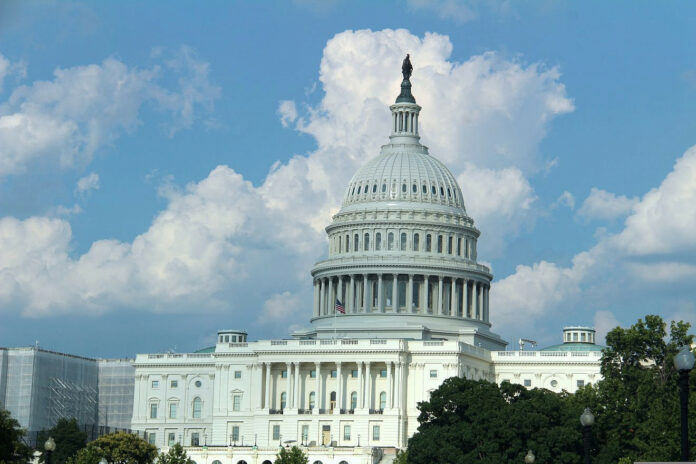
With 100 days until the midterm elections, a Decision Desk HQ forecast projects Democrats as favorites to retake control of the House of Representatives, while Republicans remain slight favorites to hold the Senate.
Both parties face significant political challenges entering the final stretch. Republicans are grappling with renewed tensions involving Iran after hopes for a winding down of the conflict faded. The latest escalation has raised fears that fighting could spread further, particularly as Iran-backed Houthis threaten shipping through the Red Sea. Increased oil prices have added pressure to the Trump administration as economic concerns remain central for voters.
Democrats confront growing internal divisions over the party's future direction. Victories by democratic socialist and anti-establishment candidates in congressional primaries have fueled moderate concerns that Republicans will portray the party as increasingly aligned with its progressive wing. President Trump and Republican leaders have made that argument central to their campaign strategy, seeking to persuade voters that Democratic control of Congress would move the country too far left.
"It's a competitive situation in both the Senate and the House," Said Geoffrey Skelley, DDHQ's chief elections analyst.
Democrats remain encouraged by House prospects, where Republicans hold only a slim majority during a midterm election year - historically favoring the party out of power. In the Senate, Democrats face a steeper climb, needing to flip several seats in states won by President Trump.
Decision Desk HQ projects Democrats winning a 225-210 House majority, while Republicans are forecast to maintain Senate control in a 50-50 chamber, with Vice President JD Vance casting tie-breaking votes. As of late July, DDHQ gives Democrats a 60% chance of winning the House and Republicans a 60% chance of retaining the Senate.
The projection reflects a tightening House race compared to earlier this month, when Democrats could have gained as many as 25 seats. On the generic congressional ballot, DDHQ's polling average shows Democrats leading Republicans by four points. YouGov/The Economist placed Democrats ahead by five points, while Morning Consult found a three-point advantage. A month earlier, the Democratic lead averaged six to seven points.
An Emerson College Polling survey gave Democrats an 11-point lead, though analysts caution it may be an outlier. Skelley said the findings "suggests a real range of opinions about what things are going to look like in the fall."
Democrats hope dissatisfaction with President Trump and frustration over a Republican-controlled Congress will translate into electoral gains, with voter concerns about the economy continuing to weigh on Trump's approval ratings.
"The big question is: will the Iranian conflict... will people being concerned about that ratcheting up, is that going to create reverberations in things like the generic ballot that signal 'OK, Democrats' advantage is growing again'?" Skelley said.
Earlier this year, Democrats' lead widened as Iran tensions intensified and gas prices climbed. As energy costs eased in spring, Republicans regained ground in polling.
"The challenge for Republicans is the Iranian conflict is heating up again," Skelley said. "This is politically very bad for the GOP. For them to try to make a case that Democrats are too extreme, it's a lot easier to make that case if economic conditions are at least OK."
A recent Economist/YouGov poll found 57% saying the war was the wrong decision. While nearly 80% of self-identified MAGA Republicans supported the military campaign, only 51% of non-MAGA Republicans expressed the same view.
"Given that President Trump was elected in part on the strength of how people viewed his handling of the economy during his first term... for polling to show sizable majorities disapproving of his handling of the economy or inflation or other things like that, it's just very bad," Skelley said.
Democrats face their own hurdles. Still searching for a clear national leader following 2024 defeats and looking ahead to 2028, Democrats remain divided over whether the party should move toward center or embrace its increasingly energized progressive base. Democratic Socialist-backed candidates have scored high-profile primary victories, while progressive challengers have defeated longtime incumbents.
President Trump has repeatedly attacked the democratic socialist movement, describing it as "communism" And "the biggest threat to our nation there is."
Republicans "are going to be, from here until the fall, trying to sort of blanket the opposition with terms like 'communists' and 'socialists,'" Skelley said.
A closely watched race next month takes place in Michigan, where centrist Democratic Rep. Haley Stevens faces progressive challenger Abdul El-Sayed in a competitive Senate primary. The winner is expected to face presumed Republican nominee Mike Rogers in a race Cook Political Report rates as a toss-up, while DDHQ views it as leaning Democratic.
Some Democrats worry that if El-Sayed wins the August 4 primary, Republicans could gain an advantage in the general election. A Republican victory in Michigan would increase the party's chances of holding the Senate to 86%.
"If Democrats are going to find a path to a majority, they cannot afford to lose Michigan," Skelley said.
Even with Democrats positioned to make House gains, Skelley cautioned the current political environment falls well short of the overwhelming Democratic momentum seen in 2018, when Democrats held a seven- to eight-point lead on the generic ballot - roughly double their current advantage.