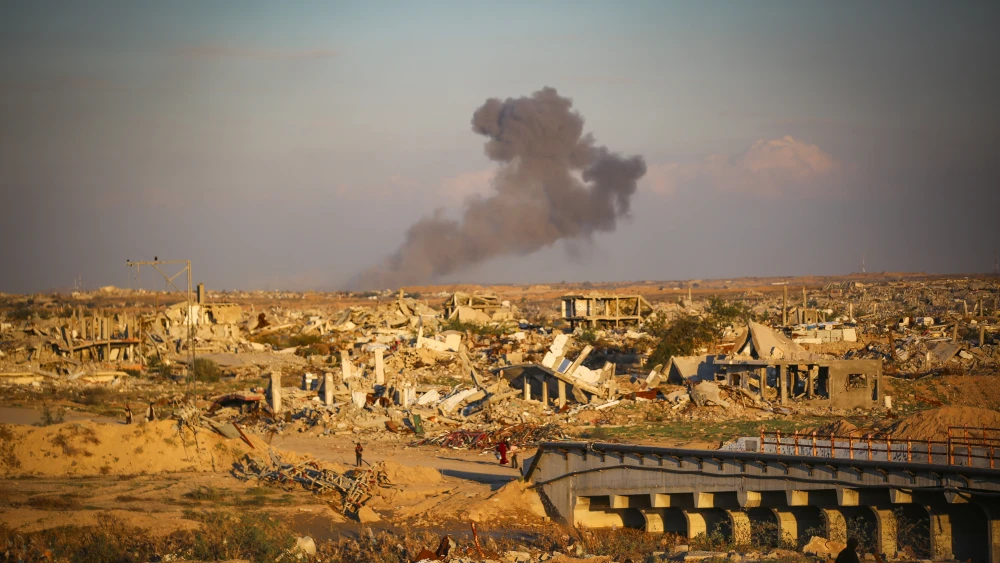
The Board of Peace released a 15-point roadmap on Thursday for implementing President Trump's Comprehensive Peace Plan in Gaza, working in conjunction with UN Security Council Resolution 2803 (2025).
The framework commits all parties to ending cycles of destruction, securing complete Israeli withdrawal from Gaza, restoring normal life, enabling Palestinian governance, and facilitating reconstruction, security, recovery and economic development alongside a credible political path toward Palestinian self-determination and statehood.
Israel must complete all remaining commitments under the Sharm Sheikh Protocol, particularly ceasing military operations. Hamas and Palestinian factions must likewise complete cessation of all military operations. Within 14 days of roadmap approval, the parties shall prepare a timetable and implementation mechanisms for Phase 2, subject to extension by the International Verification Committee (IVC). The National Committee for the Administration of Gaza (NCAG) will then enter the Strip and assume responsibilities. The IVC, comprising representatives from guarantors, the Board of Peace, and the International Stabilization Force, must certify both parties fulfill their commitments before Phase 2 proceeds.
Advancement between phases depends on verified completion of prior commitments, monitored by the IVC.
Hamas and other factions agree that all civilian governance and security functions shall transfer to NCAG, which shall operate independently without faction interference. NCAG will maintain institutional and public service continuity, treat civil servants lawfully and fairly, and conduct a comprehensive audit of Gaza's financial and administrative affairs. It shall assess legitimate commitments to suppliers and contractors up to $400 million USD and address them gradually over three years according to NCAG priorities.
Gaza shall operate under one authority, one law, and one weapon. Newly-trained police personnel shall integrate into existing structures after comprehensive vetting, with those failing standards offered alternative civilian roles or retirement in accordance with Palestinian law, retaining financial rights.
Heavy weapons decommissioning shall begin after completing Sharm Sheikh Protocol commitments, NCAG entry, and ISF deployment, administered by NCAG within 14 days - extendable by IVC decision. This process links to phased Israeli withdrawal and militia decommissioning, monitored by IVC and supported by ISF. Only NCAG shall hold, store, or control weapons afterward.
Personal weapons remain subject to Palestinian law, with NCAG as the sole registration and licensing authority. Militia weapons shall be decommissioned and stored under NCAG authority per agreed timetable, with militia members excluded from security and police services.
A Social Peace Agreement shall commit parties to ending internal violence, avoiding reprisals and armed demonstrations.
A temporary International Stabilization Force shall deploy to separate Israeli and NCAG-controlled areas, monitoring ceasefire compliance, training Palestinian police, securing humanitarian assistance delivery, and supporting NCAG in non-policing missions.
Israeli forces shall complete phased withdrawal consistent with the peace plan. NCAG shall handle internal security incidents.
Reconstruction shall proceed according to a plan and timetable prepared and supervised by the Board of Peace and NCAG in accordance with relevant laws and international standards.