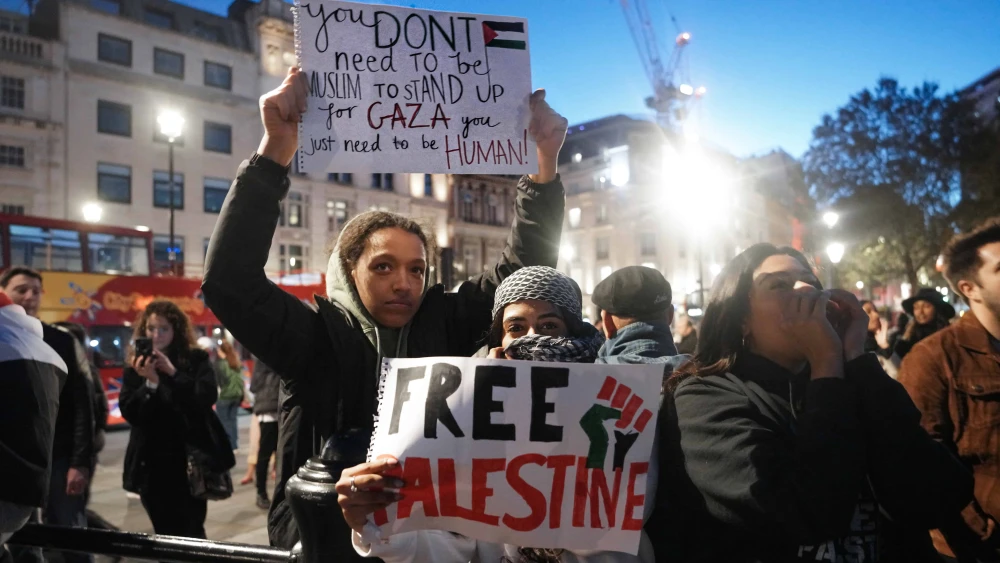
Britain experienced its largest and most sustained anti-Israel protest movement in Europe following Hamas's October 7, 2023, attack, with hundreds of thousands demonstrating in London. However, a new report from NGO Monitor, a Jerusalem-based research institute, found that these demonstrations - while appearing grassroots - were actually organized by a small network of professionally structured, internationally funded groups promoting anti-Israel and anti-Western narratives.
The report, presented at a House of Lords event on July 8, characterizes the network as concentric circles: hostile states, terrorist groups and extremist movements at the center, surrounded by charities and advocacy organizations that amplify propaganda and legitimize extremist agendas.
Analyzing 40 major anti-Israel protests in Britain, researchers identified six core organizers involved in 32 of the demonstrations: Stop the War Coalition, Friends of Al-Aqsa, Muslim Association of Britain, Palestinian Forum in Britain, Palestine Solidarity Campaign, and Campaign for Nuclear Disarmament. Anne Herzberg, NGO Monitor's legal adviser, noted that Stop the War Coalition and Campaign for Nuclear Disarmament - neither ostensibly focused on Israel-Palestine - took leading roles to link anti-Israel activism with broader anti-Western campaigns.
The same individuals held positions across multiple organizations. Former Labour Party leader Jeremy Corbyn serves as vice president of Campaign for Nuclear Disarmament, deputy president of Stop the War Coalition, and patron of Palestine Solidarity Campaign.
Fifteen additional groups, including Amnesty International, Code Pink, and Oxfam, sponsored between one and three protests. Herzberg highlighted Amnesty UK's youth training program for ages 16-24 as exemplifying how mainstream organizations transmit extremist narratives.
A significant concern was funding opacity. Four of the six main groups - Friends of Al-Aqsa, Muslim Association of Britain, Palestinian Forum in Britain, and Palestine Solidarity Campaign - had no identifiable funding sources. Several registered as companies rather than charities to avoid reporting requirements.
Lord Walney, the government's former independent adviser on political violence (2020-2025), warned in the report's foreword that "a troubling number of the organizations within [the anti-Israel network] either fall outside any meaningful regulatory framework or maintain connections to actors that no democratic state should tolerate."
Some organizations' extremist connections were documented: the Muslim Association of Britain was founded by a former Hamas political bureau member; the Islamic Human Rights Commission was identified by an independent 2023 U.K. Review as "ideologically aligned with the Iranian regime."
Herzberg attributed weak enforcement to political calculations, saying Labour Party fears antagonizing supporters of these groups. "If they actually started enforcing the laws, they would make a lot of their constituents very angry," She said.
She emphasized that the issue extended beyond Britain, stating: "This wave of destabilizing protests has highlighted a crisis of transparency across Western countries, where registered and unregistered groups that people know nothing about have co-opted everyday life in service of overseas actors with their own agendas."