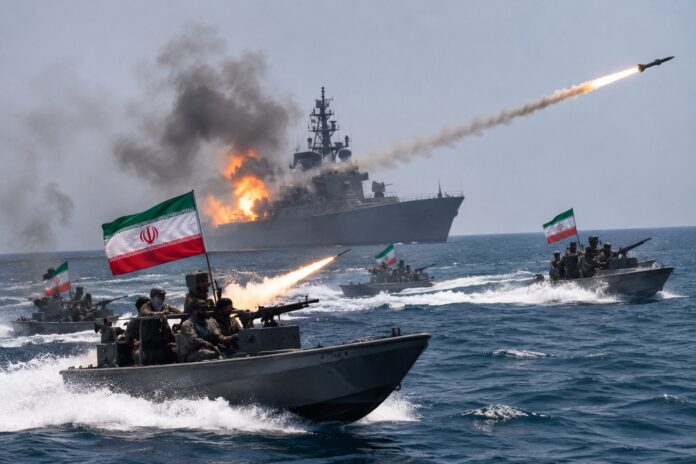
Tensions escalated sharply in the Middle East on Tuesday following an Iranian attempt described by U.S. Military officials as a "surprise attack" On American forces, occurring amid reported significant progress in diplomatic cease-fire discussions.
The confrontation came as the United States and Saudi Arabia conducted coordinated strikes against Iran-backed terrorist targets in Iraq, responding to a series of attacks by Islamic Revolutionary Guard Corps-directed forces on American personnel in the region.
U.S. Central Command reported that American and Saudi warplanes struck terrorist logistics hubs and weapons facilities shortly after Iran attempted a coordinated assault on U.S. Forces across the Middle East. CENTCOM stated the IRGC orchestrated more than 30 drone attacks over three days, all of which were successfully intercepted.
"From February through April 2026, there were more than 600 attempted attacks on U.S. citizens and facilities by Iran-aligned terrorist militias in Iraq," CENTCOM said. "The IRGC and its terrorist proxies must cease these attacks to avoid further U.S. military response."
Later Tuesday, CENTCOM reported Iranian forces attempted another escalation by firing multiple ballistic missiles toward American positions, described as an "attempted surprise attack." U.S. Forces intercepted the incoming missiles before impact.
The military developments coincided with diplomatic negotiations between Washington and Tehran reporting "significant" Progress on cease-fire discussions. President Trump, who paused additional military strikes against Iran on Friday, expressed cautious optimism about diplomacy while warning of potential renewed military action.
"You know, they wanted to talk.... we're having good talks, so we'll see what happens," Trump said. "I think there's a good chance that something could happen, and if it does, good. If it doesn't, we go back to doing what we were doing two days ago."
The United States, Qatar, Pakistan, and Egypt are facilitating ongoing negotiations between Iran and Oman regarding administration of the Strait of Hormuz. Omani mediators indicated discussions over a fair management structure have been complicated by proposals involving new fees for passing vessels. One proposal would allow Iran and Oman to collect service fees for maritime security. Another concept would model the arrangement after the Strait of Malacca, where three nations jointly oversee security through fee-funded systems.
The Trump administration has insisted the Strait of Hormuz remain open to international shipping without new restrictions or tolls, maintaining the waterway should continue operating freely as before the conflict.