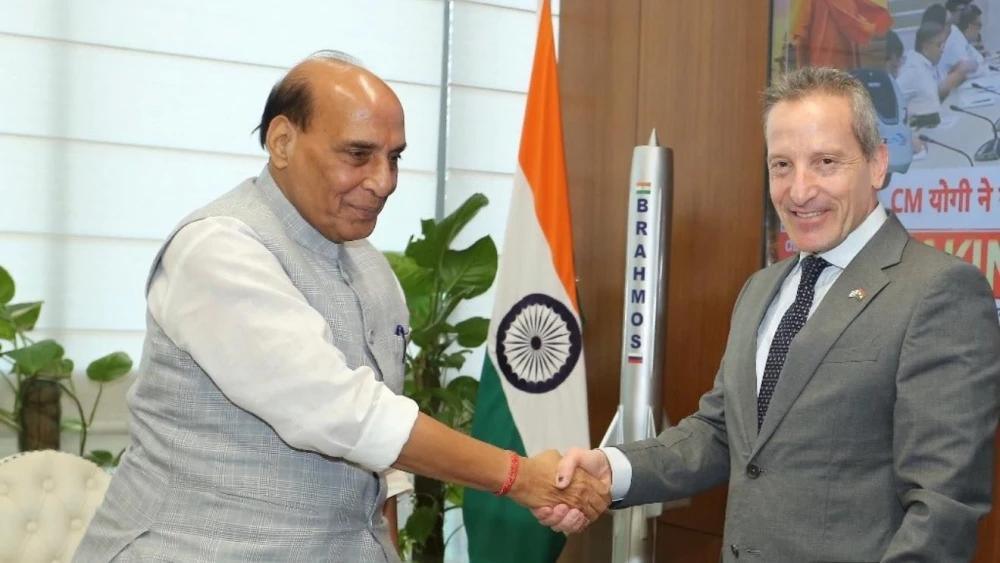
Israel and India are expanding a defense and strategic partnership that extends beyond weapons sales to encompass water technology, trade corridors and shared regional strategic interests, according to former Israeli officials.
In June, Israeli Defense Ministry Director General Maj. Gen. (res.) Amir Baram led an official delegation to India for high-level meetings with India's defense minister, defense secretary, chief of defense staff and other senior defense officials to discuss expanding bilateral defense and industrial cooperation.
Meir Ben Shabbat, Israel's former national security adviser and current head of the Misgav Institute for National Security, characterized the relationship as having "supreme strategic importance" With potential impact on Israel's security, economic and political resilience. He identified India as Israel's largest defense customer, a role that finances research and development for the Israeli military.
The partnership encompasses intelligence sharing on terrorism and border security, and Ben Shabbat noted that it reduces Israel's dependence on Western support alone. Joint weapons production with India also helps secure Israel's supply of raw materials during emergencies, he said.
Ben Shabbat described the Israel-India relationship as part of a broader structure, stating, "The partnership between Israel, India, the United States and the United Arab Emirates creates a powerful economic-strategic corridor connecting Asia, the Middle East and Europe, with the potential to connect additional countries."
He also cited India as a significant market for Israeli civilian technology, particularly in cyber and communications sectors, and credited Indian Prime Minister Narendra Modi with advancing the relationship throughout the war period.
Micky Aharonson, former head of the foreign relations directorate of Israel's National Security Council and now a partner at 6.8 Ventures, argued that framing the relationship purely around weapons sales understates its significance. She emphasized that national security encompasses military matters alongside water, food and agricultural security.
Israel's desalination, wastewater purification and irrigation technologies address India's water shortages caused by severe climate pressures, Aharonson said.
She highlighted the India-Middle East-Europe Corridor as a central strategic project connecting India through the UAE, Saudi Arabia, Jordan and Israel to Europe. She also identified a competing route through Iraq and Syria as a potential strategic threat, though she noted Syria's instability as an impediment.
Aharonson pointed to I2U2 - the economic and technology framework linking Israel, India, the UAE and the United States, launched in October 2021 - as an underappreciated pillar involving food security, water, renewable energy and supply chains. Agricultural parks have been established in India under the framework's cooperation.
China emerged as a primary driver of India toward Israel, Aharonson said, citing military confrontations in the Himalayas and concerns over China's regional port and base presence in Pakistan, Sri Lanka, Myanmar and Djibouti. Pakistan and Islamist militant groups also concern India, as do vulnerabilities in Indian Ocean shipping lanes.
During the June visit, Baram stated, "India is a key strategic partner of the State of Israel. A bond rooted in shared values, deep cultural appreciation, and mutual trust that goes well beyond mere interests."
Israel and India agreed to arms deals worth $8.6 billion in 2026, according to reporting citing Forbes India, including Rafael's SPICE 1000 precision-guided bombs, Elbit Systems' Rampage missiles, Israel Aerospace Industries' Air Lora air-launched ballistic missiles and Rafael's Ice Breaker missile system.
India has been Israel's largest defense customer for years, accounting for 34 percent of Israeli arms sales between 2020 and 2024, with total sales during that period reaching roughly $20.5 billion. India has also signed multiple contracts with Israel Aerospace Industries for Barak 8 air-defense systems valued at more than $3 billion combined.
Aharonson described India as a valuable complement to Israel's alliance with Washington, allowing Israel to benefit from a broader coalition of democratic partners.