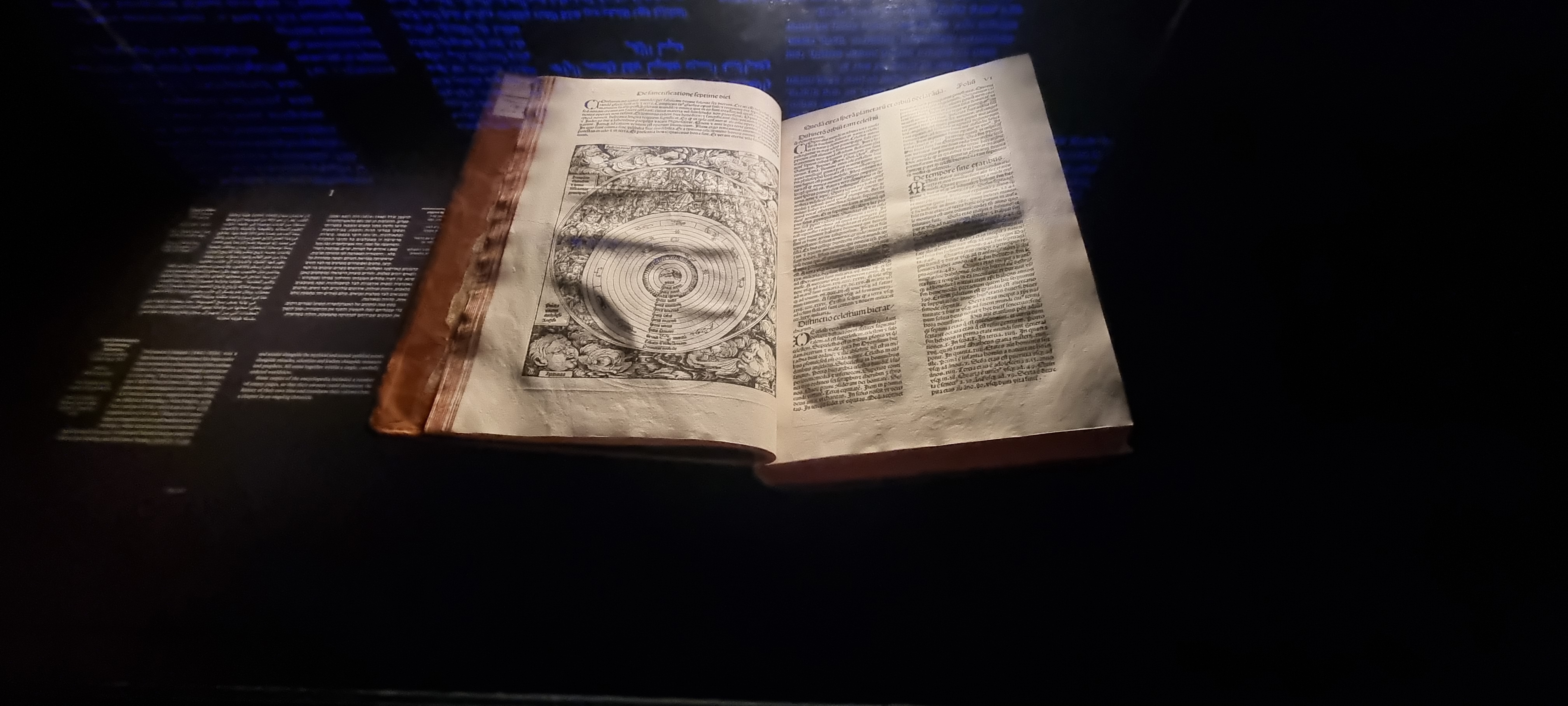
Can science and faith coexist? Is humanity guided by reason, revelation or both? For more than a thousand years, scholars from Jewish, Christian and Muslim traditions grappled with those questions.
Beginning July 31, the National Library of Israel opens a major exhibition featuring rare manuscripts, scientific writings and religious texts - many displayed publicly for the first time - that explores this shared intellectual heritage across cultures and generations.
The Quest of Questions - Unlocking the Secrets of the Universe examines enduring questions that have occupied humanity for centuries rather than presenting a chronological history. Co-curator Noa Menhaim said the display was designed to be "inclusive of Jewish, Christian and Arabic works" And to "show the multicultural religious and philosophical schools of thought."
Visitors move through two dimly lit galleries where black walls direct focus to priceless manuscripts. The exhibition draws on the library's collections to explore astronomy and astrology, algebra and geometry, theology and Kabbalah, medicine and alchemy, presenting Jewish, Christian and Muslim traditions alongside scientific discovery and philosophy. Display texts appear in Hebrew, Arabic and English.
Among the opening works is the Nuremberg Chronicle, published in Germany in 1493 and considered one of the finest illustrated examples of early European printing. An illuminated manuscript of Maimonides' Mishneh Torah represents Hebrew manuscripts that shaped Jewish scholarship throughout Europe and the Middle East.
A notable section reveals Sir Isaac Newton's lesser-known theological writings - papers on biblical prophecy, the Temple in Jerusalem and calculations concerning the End of Days - displayed alongside his scientific manuscripts. Nearly 8,000 handwritten pages of Newton's papers reached the National Library with support from Albert Einstein, who recognized the importance of his theological writings.
The exhibition also features The Canon of Medicine by Avicenna, Persian manuscripts, Armenian biblical illustrations and works by Kepler, Galileo, Saadia Gaon, Gersonides and Ibn Rushd.
National Library CEO Oren Weinberg said the exhibition "offers an opportunity to step back from the relentless pace of current events" And to "reflect not only on the immediate concerns that occupy our attention, but also on the enduring questions that have challenged humanity across civilizations and generations."
Audio guides and family programming will accompany the exhibition. Pages will be rotated approximately every three months to preserve fragile manuscripts.
The exhibition runs through March 2027 at the National Library of Israel in Jerusalem.