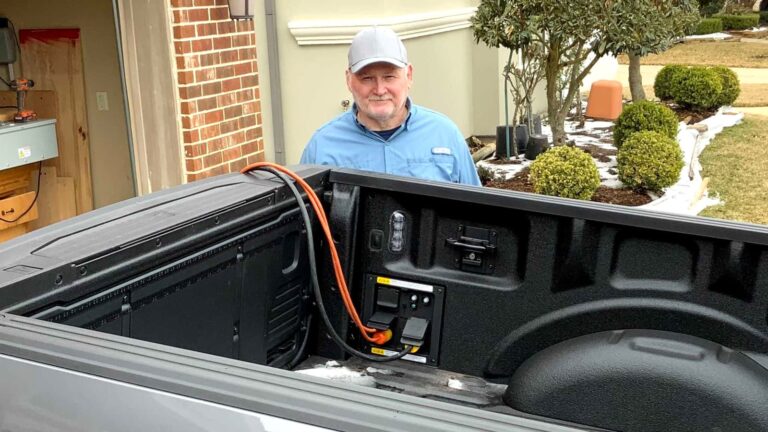
Winter Storm Uri, which struck Texas in February 2021, prompted one New Braunfels resident to seek backup power solutions after being unable to run his septic tank during the outage. When Kenneth Kovar, 64, purchased a Ford F-150 last fall, he hoped to be better prepared for future crises.
Ford now offers a system allowing certain F-150 models to connect directly to a home's electric meter to supply power during outages. Drivers of the F-150 PowerBoost hybrid and F-150 Lightning electric trucks can plug a one-foot adapter into a 240-volt outlet on the vehicle, which connects via cable to a transfer switch at the home's meter. This allows homeowners to selectively power devices through their breaker box. The Lightning can provide power for two to three days depending on usage, while the PowerBoost Hybrid can supply up to five days on a single tank of gas.
Ford positions its solution as less expensive than conventional standby generators, which require costly installation. The Ford system, starting around $1,100, also requires professional installation at the meter. The setup currently applies to approximately 200,000 vehicles and functions for outages only, though Ford offers a separate Home Integration System for bidirectional power flow.
Other automakers are advancing similar technologies. Kia partnered with charging company Wallbox to enable compatible vehicles to provide home backup power during outages or high-demand periods. Tesla vehicles equipped with the appropriate hardware can connect to homes, with the Cybertruck offering full vehicle-to-home capability. General Motors partnered with WeaveGrid to allow certain EV owners to participate in grid reliability programs, with the vehicle-to-home technology detecting outages and supplying home power.
These capabilities address both growing grid demand and an EV sales slowdown in the U.S., with pure EV sales down 23.8% year-over-year in the first half of 2026. Implementation faces obstacles including third-party safety testing, vehicle-charger communication requirements, and utility approval processes that can take years. Customers must also understand their vehicles' capabilities and manage the systems accordingly.