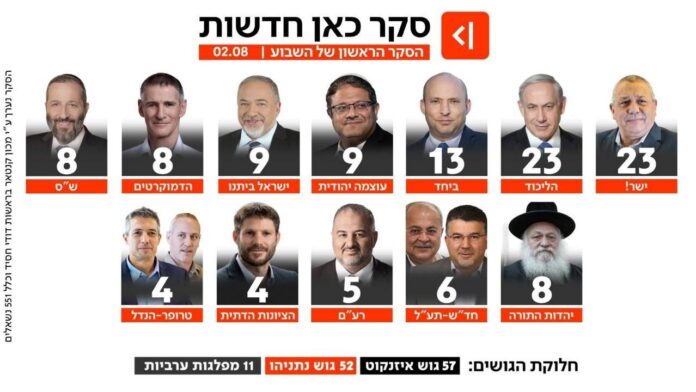
A Kan News poll released Sunday evening shows Netanyahu's Likud and Eisenkot's Yashar party each commanding 23 Knesset seats, with Likud gaining one seat week-over-week and Yashar climbing two seats to reach parity.
Bennett's Beyachad party declined by one seat to 13 mandates, while Golan's Democrats dropped two seats to eight. Hadash-Ta'al gained one seat to reach six. Otzma Yehudit and Yisrael Beiteinu each held at nine seats, with Shas and United Torah Judaism remaining at eight apiece. Religious Zionism fell one seat to four mandates, while the joint party led by Hendel and Tropper cleared the electoral threshold with four seats.
In bloc terms, Netanyahu's coalition maintained 52 seats against an opposition bloc of 57 led by Eisenkot, with Arab parties holding 11 mandates collectively.
A hypothetical scenario introducing right-wing parties led by Erdan, Edelstein, and Winter saw neither cross the threshold. The Democrats would gain one seat to nine, while Otzma Yehudit would fall to eight. A separate scenario testing MK Yoav Segalovich joining Ra'am left that party at five seats with no change to overall bloc balance.
On leadership preference, 40 percent of respondents said Netanyahu was best suited as prime minister compared to 31 percent for Bennett. Netanyahu also led Eisenkot 40 percent to 36 percent in a direct matchup, while Eisenkot held commanding advantage over Bennett at 37 percent to 15 percent.
On a potential Gaza agreement with Hamas, 45 percent of respondents opposed such a deal, 27 percent supported it, and 27 percent were unsure.