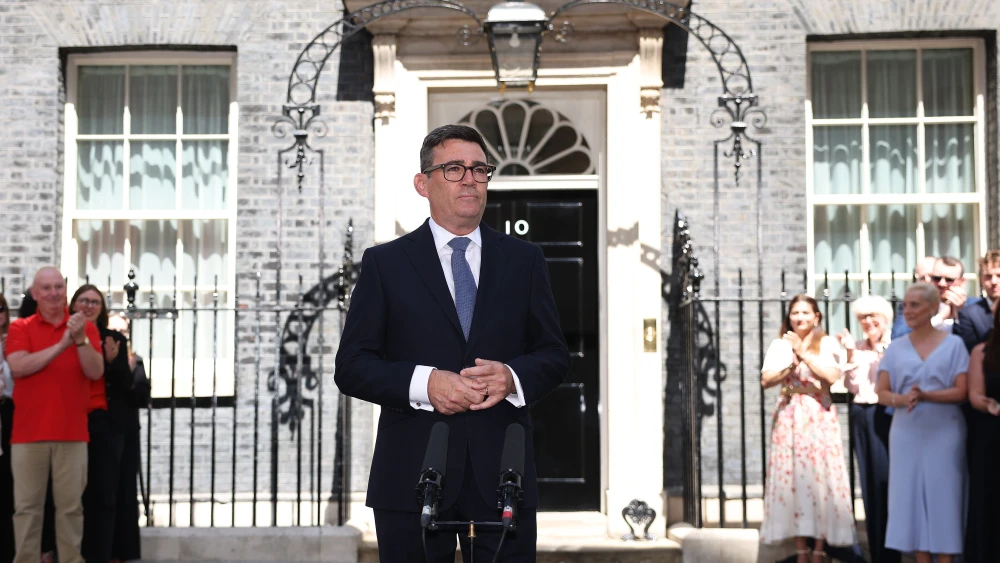
Andy Burnham became Britain's prime minister on Monday, becoming the country's seventh leader since 2016 after Keir Starmer resigned following internal pressure and political setbacks.
The 56-year-old former mayor of Greater Manchester was elected Labour Party leader on July 17 after running unopposed, securing backing from Labour lawmakers and party members following Starmer's announcement that he would step down as party leader.
Outside 10 Downing Street, Burnham vowed to "make this moment a circuit breaker for Britain." He pledged to "change politics, to make it more collaborative, more about problem solving than point scoring" And said the government would "take power out of here and carry it into every postcode in the land so that they can do more - and in doing so, build a new economy where we put life's essentials back under stronger public control to make them affordable to you again."
The prime minister outlined a "10-year plan" Aimed at addressing the cost-of-living crisis, reducing homelessness and expanding public control over essential services, alongside promised reforms to education, increased mental health support for young people and more public housing.
In comments to The Guardian on July 17, Burnham said many believed Starmer's government "didn't get it right" Regarding Israel's war against Hamas in Gaza. "I am sorry about that. The response has too often not been good enough. We need to do better," He told the newspaper. He also said there was "increasing evidence that war crimes appear to have been committed" In Gaza, but stressed that "it must be for the international courts to determine, rather than politicians." Burnham called for consideration of further sanctions on Israel and said Britain should examine banning trade in goods from illegal settlements, adding there was "no contradiction between a zero-tolerance approach to antisemitism and holding the Netanyahu government to account."
Phil Rosenberg, president of the Board of Deputies of British Jews, congratulated Burnham on his commitment to tackling antisemitism. Chief Rabbi Ephraim Mirvis also welcomed his appointment, stating Burnham "assumes the immense responsibility of leadership at a time of great challenge, both at home and abroad."
Starmer formally resigned to King Charles III at Buckingham Palace on Monday, and Burnham subsequently met with the king, who invited him to form a new government. In his final address as prime minister, Starmer thanked the public "for the opportunity to serve" And said of Burnham, "He has my full support."