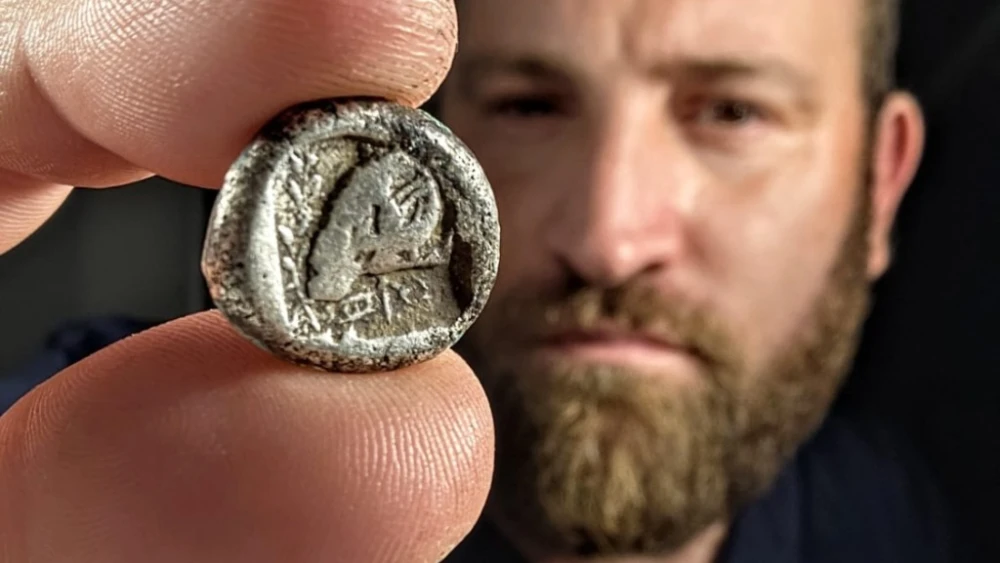
A deputy director of the Ashdod Beaches Department discovered a 2,500-year-old coin from Cyprus while searching for lost objects on an Ashdod beach approximately a month ago. Upon submission to the Israel Antiquities Authority, examination by the authority's coin department confirmed the find to be an exceptionally rare specimen never before recorded in the country.
The coin, weighing roughly 11 grams, features a left-facing recumbent ram on one side and a left-facing ram's head within a sunken square frame accompanied by a vertical laurel branch and three symbols believed to belong to Cypriot syllabic script on the other. Analysis revealed the object to be metal plated with silver rather than solid silver.
According to the Antiquities Authority, the coin was minted in the ancient city of Salamis on Cyprus's eastern coast around the middle of the 5th century BCE during Persian rule. It represents a standard denomination known as a siglos.
Yaniv David Levy, a researcher and curator in the Antiquities Authority's coin department, noted that "Coins of this size and value from the Persian period are rare altogether in the archaeological record." He explained that such silver coins were typically cut into pieces for local trade over time, making a complete coin from a coastal area "unusual on all accounts, and of special historical importance."
Dr. Evangeline Markou, a senior researcher at the Institute of Historical Research at the National Hellenic Research Foundation in Athens and expert on ancient Cypriot coinage, stated that "Salamis coins from the 5th century BCE were circulating throughout the Eastern Mediterranean. However, finds with an exact provenance are rarer, and therefore this coin potentially offers significant information about trade ties and movement between Cyprus and the Land of Israel during this period."
Levy emphasized the scholarly value of accurate reporting: "The circumstances of the discovery and the accurate reporting allow us researchers not only to identify the coin itself, but also to use it as a reliable source of information about economic and maritime ties that existed in this region some 2,500 years ago."
Israeli Heritage Minister Rabbi Amihai Eliyahu called the discovery "tangible evidence of the maritime and commercial ties that existed between the Land of Israel and Cyprus some 2,500 years ago," Noting that public cooperation in reporting antiquities enables preservation of shared heritage.