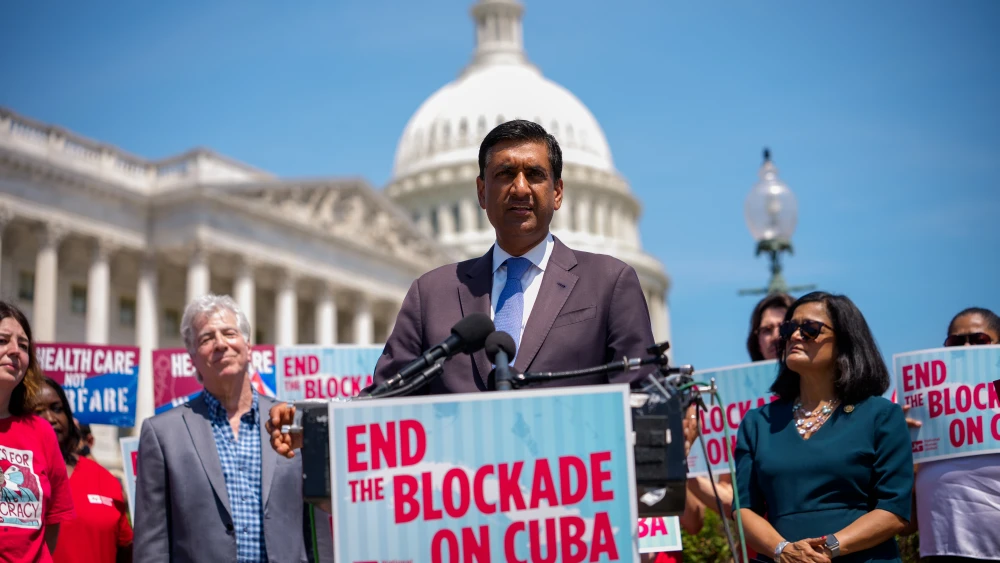
U.S. Congressman Ro Khanna spent 72 hours touring Palestinian Authority-controlled villages in Judea and Samaria without coordinating the visit with Israel's Foreign Ministry, the Israeli embassy in Washington, the U.S. Embassy in Jerusalem or Israeli security forces.
Khanna characterized his visit as a trip to "Palestine." His itinerary was arranged by Breaking the Silence, an Israeli advocacy group, and he traveled with activists tied to J Street, an American organization that has lobbied against the Israeli government since 2008.
On July 8, 2026, Khanna's unmarked convoy was stopped on the road. New York Times reporters and cameras captured the encounter with Israeli civilians, police and the IDF. Jewish residents of nearby communities, unaware of changes to the area's designation and suspicious of the unidentified convoy, alerted authorities, who delayed the group until receiving clearance orders.
Footage uploaded by Breaking the Silence activist Nadav Weiman shows Khanna was not harassed. After his identity as a U.S. Congressman was established, the convoy was allowed to proceed. Khanna subsequently declared on X that Israeli settlers carrying American-made M4 rifles had "detained him" And that the IDF "sided with the settlers." He referred to the areas visited as "Palestine," Though they remain under Israeli security control under the Oslo Accords. He told The New York Times that Israel would be wise not to detain "long-shot presidential candidates."
In August 2019, Israel barred U.S. Congressional Reps. Rashida Tlaib and Ilhan Omar from a similar trip after President Donald Trump urged Prime Minister Benjamin Netanyahu to deny them entry. Israel's initial agreement followed by reversal drew criticism even from allies in Congress.
Khanna has called for halting all weapons transfers to Israel, including missile defense funding. Democratic Congressman Josh Gottheimer characterized Khanna's trip as a "presidential campaign cameo" And noted Khanna ignored requests to meet October 7 survivors and hostage families.
Former Chicago Mayor Rahm Emanuel delivered a speech the same day as Khanna's incident, emphasizing Israel's diplomatic isolation and recommending cutting American defense budget subsidies for Israel and sanctioning Israelis who attack Palestinian civilians.
A June 22, 2026 poll found the vast majority of the Israeli public rejects a two-state solution. Both Khanna and Emanuel align with J Street, founded in 2007 as a more progressive organization. While J Street has labeled itself "pro-Israel, pro-peace," Its positions suggest alignment closer to Palestinian narratives on borders and settlements.
The episode reveals a failure of Israel's strategic communications structure to prevent or respond to such provocations before they generate international headlines. Israel requires enhanced capacity to anticipate and manage these visits through coordinated diplomatic and information security channels.