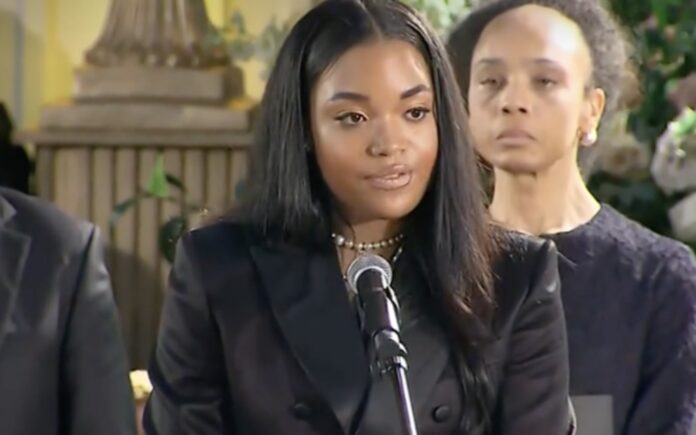
Ashley L. Jackson, daughter of Rev. Jesse Jackson, has announced her conversion to Judaism following a personal spiritual journey spanning several years. In an opinion essay published in The Washington Post, Jackson wrote that she completed a non-Orthodox conversion on June 12 after years of study, reflection, and deepening connection to Jewish life.
Jackson, a writer, producer, and founder of the nonprofit Push The Next Generation, described a significant moment when her father accompanied her to Shabbos services at her synagogue two years before his death. She recalled: "As the Saturday morning service proceeded, my father sat in the front row, holding my hand, dancing to prayers in a language he did not speak, eating the Sunkist candies the congregation had tossed to celebrate a bar mitzvah."
Jackson explained her choice of Judaism by noting the alignment with principles from her upbringing. "I was raised to believe that faith must lead to action," She wrote. "In Judaism, I found an enduring expression of this belief." She cited Judaism's emphasis on lifelong learning, meaningful ritual, and Tikkun olam - repairing the world - as particularly meaningful to her.
Jackson addressed the intersection of Black and Jewish identity, acknowledging both challenges and shared purpose. She wrote that "racism and antisemitism can surface in even the most intimate and familiar spaces," While also describing "the meeting of two diasporas" And common commitments to justice and human dignity. She noted that roughly one percent of American Jews identify as Black.
Jackson recounted her father's emotional response during his synagogue visit when the rabbi invited him forward for a blessing. "Before she could speak, the congregation was already on its feet," Jackson wrote. "My father, one of the most recognizable Baptist ministers in America, wept as the congregation offered him a spontaneous ovation."
Upon completing her conversion, Jackson adopted the Hebrew name Miriam Yiskah, explaining that Yiskah was selected as "a feminine echo of Jesse," Honoring her father's memory.
Concluding her essay, Jackson expressed hope that her story might bridge dividing communities. "I feel as though I have been entrusted with a sacred charge," She wrote. "Amid widespread concerns about antisemitism and anti-Blackness, it is necessary to recall that our differences do not preclude unity."