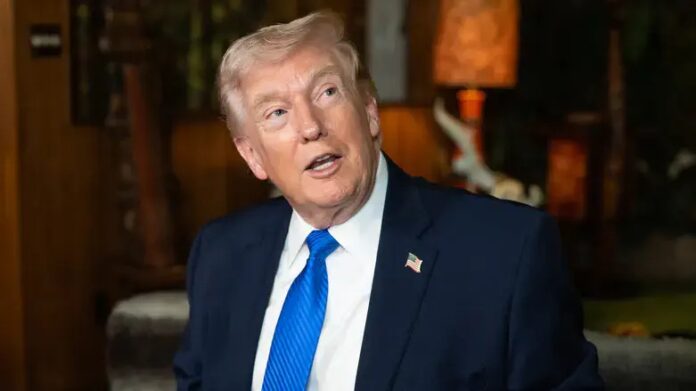
President Donald Trump issued forceful warnings on Tuesday, stating that the United States will continue targeting Iran's nuclear infrastructure and any facilities connected to its weapons program, with the possibility of additional military action in the near term.
At the White House, Trump reiterated that Iran will never be permitted to acquire a nuclear weapon and cautioned that any location associated with such efforts would remain a target. "Any site where they're even thinking about nuclear, we'll be hitting it very, very powerfully," Trump said.
Trump asserted that recent U.S. Military operations have inflicted significant damage to Iran's capabilities, claiming the harm would require decades to repair. "Now, nobody knows except the Iranians the damage that we've done to them. We have done damage that will take them 20, 25 years to recover from. So if we left tomorrow, we had a big success. But we're not leaving tomorrow," He said.
Trump also suggested that another major strike could soon target Pickaxe Mountain, an underground complex near the Natanz nuclear facility that international inspectors have not been permitted to access. When asked whether Iran had transferred uranium enrichment centrifuges to the site, Trump indicated it was possible while emphasizing that U.S. Intelligence monitors Iran's nuclear materials closely. "They may have," He said, "we follow the material, that's where the action is."
He signaled imminent military action against the location. "We'll be hitting that area very, probably pretty soon. And there's not a thing they can do about it. You know, normally I wouldn't say that. If I thought they could do something about it, I would never say that. But we'll be hitting that area pretty soon and very heavily," Trump said.
Trump stated that Iran is now seeking negotiations following repeated U.S. Strikes against its military assets. "They can not have a nuclear weapon and they won't have, they have no chance of having a nuclear weapon... But we are doing very well. We are degrading them at levels that nobody thought was possible," He said.
He acknowledged that one recent Iranian attack in Jordan killed American troops. "They're being degraded, really so seriously. They did slip something through in Jordan," Trump said.
Secretary of War Pete Hegseth noted that the United States has maintained intense pressure on Iran following ten consecutive days of strikes by U.S. Central Command. Hegseth stated that Tehran has been offered opportunities to negotiate but has continued threatening international shipping. "If they're going to shoot a commercial shipping, then we're going to hit them, as the president said, ten times harder, which every night we're degrading them further and further," He said.
Trump praised a U.S. Naval blockade surrounding Iranian ports as nearly impenetrable, with CENTCOM announcing that forces have redirected multiple commercial vessels and prevented ships from entering or leaving Iranian ports since the blockade resumed.
The President also warned Iran-backed Houthi forces in Yemen against disrupting Red Sea shipping. "We'll see what happens. So far, it hasn't happened. Might happen, but we take care of things."
Iran launched fresh missile and drone attacks against neighboring countries. Bahrain activated nationwide warning sirens following Iranian claims of attacking Sheikh Isa Air Base, while Kuwait reported intercepting incoming Iranian missiles and drones. Three explosive drones were intercepted near the U.S. Consulate in Erbil, temporarily halting airport operations.
The State Department issued a worldwide security alert, noting that "due to heightened tensions in the Middle East, the security environment remains complex with the potential for unforeseen escalation." The advisory warned that "U.S. diplomatic facilities, including outside the Middle East, have been targeted. Iran and groups supportive of Iran may target other U.S. interests overseas or at locations associated with the United States and Americans throughout the world."
The Department advised Americans in the Middle East to prepare for possible flight cancellations and temporary airspace closures, recommending that travelers reconsider nonessential travel to the region.