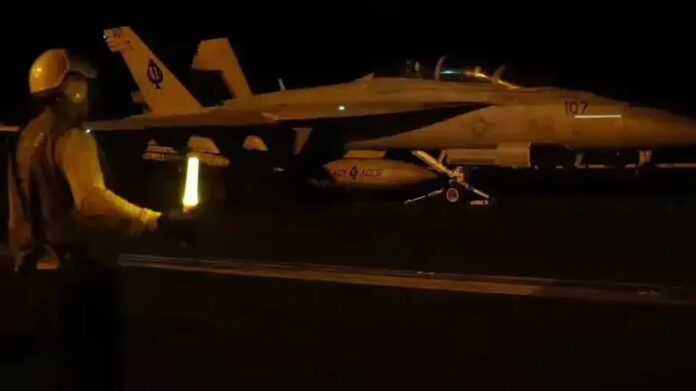
The United States conducted airstrikes against Iranian targets in the early morning hours Thursday, escalating tensions following President Donald Trump's warning of retaliation for Iran's overnight attack on American forces in Jordan.
A senior U.S. Official confirmed to Channel 12 News that American forces began striking targets across Iran. U.S. Central Command stated, "US forces began launching strikes against Iran at 8 p.m. ET today. The strikes are a powerful response to yesterday's attempted Iranian attacks on U.S. forces based in the Middle East."
Iranian media reported explosions in multiple locations, including Nurabad in Fars Province, the southern port city of Sirik, and Ahvaz. Additional reports indicated three blasts on Qeshm Island in the Strait of Hormuz and another explosion in Bushehr.
Trump had announced the impending response hours earlier, telling reporters, "We are going to hit them very hard. I can say that because there is very little they can do about it." He elaborated that Iran had launched five rockets the previous night, all of which were intercepted, and said, "We're going to be hitting them very hard, because it's our turn to hit them. They know it's coming, they're asking us not to do it."
Earlier, Trump told Fox News, "We are going to beat the ing out of them" And "We'll be hitting them hard. They are going to get a beating."
Trump characterized Iran's missile strike as a surprise attack, noting that U.S. Forces had only minutes to intercept the incoming projectiles.
The Wall Street Journal reported that Trump was considering whether to expand the military campaign against Iran. Military planners had prepared options for an intensive aerial operation lasting 10 to 14 days focused on destroying Iran's missile capabilities. A U.S. Official told the outlet that as of Wednesday afternoon, Trump had not finalized decisions on the operation's scale or specific targets. The official added that Trump was "in an escalatory mood" While senior administration officials continued evaluating the next phase of response.