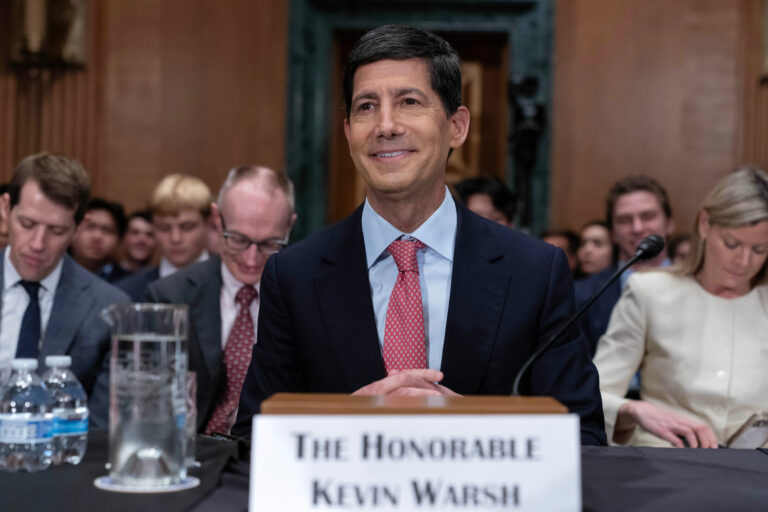
The Federal Reserve is expected to hold its key interest rate steady at its upcoming meeting, but Chair Kevin Warsh faces mounting pressure to raise rates soon - a decision that could draw backlash from President Donald Trump, who appointed him.
Multiple factors threaten to keep inflation elevated. Renewed conflict in Iran has pushed oil and gas prices higher, a trend expected to worsen inflation in coming months. Massive investment in artificial intelligence infrastructure is raising prices for laptops, smartphones and electricity. Also, tariffs imposed by Trump on numerous trading partners could fuel further price increases.
These pressures may cause only temporary price spikes rather than sustained inflation like that seen in 2021-2022. However, inflation by the Fed's preferred measure has exceeded its 2% target for more than five years. Core inflation, which excludes energy and food, has risen since last December and remained at roughly 3% or higher since 2023. Without meaningful improvement, some Fed officials have indicated rate increases will become necessary.
"Unfortunately, inflation does not appear to be headed sustainably back all the way to 2%," Said Lorie Logan, president of the Federal Reserve Bank of Dallas. "Modestly higher interest rates would better balance the outlook."
Since becoming chair in May, Warsh has committed to returning inflation to 2% without detailing his approach. In congressional testimony this month, he stated the Fed has "no tolerance" For higher inflation, and in its first rate statement under his leadership, the central bank pledged to "deliver price stability." These remarks, combined with rising oil and gas prices, have already pushed up borrowing costs, with the 10-year Treasury yield briefly reaching 4.7% last Thursday, its highest level in roughly 18 months.
However, such rhetoric creates expectations for concrete action. "Markets are going to ask, 'Well, what have you done for me lately?' And they're going to demand action," Said James Bullard, a former president of the St. Louis Fed.
More Fed officials are growing frustrated with inflation's persistence. Christopher Waller, an influential Fed board member, stated in a July 13 speech that "sternly staring at inflation until it melts before our withering gaze is not an option." If core inflation continues climbing, the committee "will need to consider" Hiking rates "in the near term," He said.
The most recent inflation data offered some encouragement. Core inflation cooled notably in June, and headline inflation fell sharply as gas prices declined nearly 10%. Apartment rent growth has slowed considerably from pandemic peaks.
"There are encouraging reasons to expect that inflation has peaked and should edge down in the coming quarters," Said John Williams, president of the New York Fed.
Yet the Middle East conflict has pushed gas prices back above $4 a gallon nationally, likely raising headline inflation before the Fed's September meeting. Higher interest rates can reduce demand and lower inflation, but cannot address supply disruptions from conflict.
In congressional testimony, Warsh suggested the Fed's role is to prevent isolated price increases from "broadening out" To other sectors of the economy. He may be counting on his tough rhetoric to accomplish this without rate hikes.
"They are hoping and intending to talk the talk without having to walk the walk," Said Stephen Douglass, chief economist at NISA Investment Advisors.
However, some economists argue inflation cannot be controlled through rhetoric alone. "There has never been a time when inflation gradually moderated without impetus from the Fed," Said Joseph Lavorgna, chief economist at SMBC Americas.