Rav Moshe Hillel Hirsch on Finding Joy in Torah, Meaning in Tefillah, the Draft Crisis, Parnassah and the Challenges Facing Yeshiva Bochurim
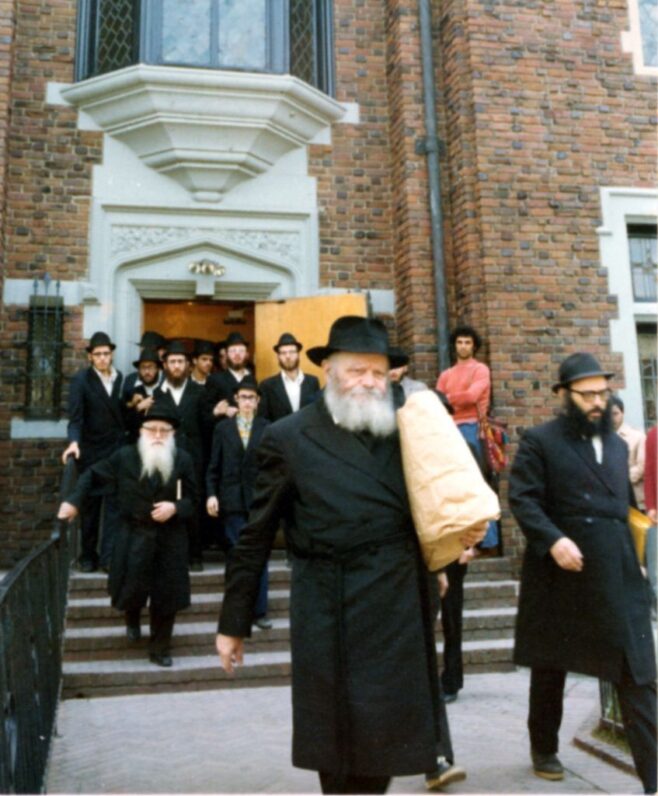
Hundreds of yeshiva bochurim gathered recently for the "Bnei Hayeshivos Conference" At Chafetz Chaim, culminating in an annual event attended by senior Torah leaders and led by Rav Moshe Hillel Hirsch. As Hirsch arrived, bochurim sang while leading roshei yeshiva from institutions including Mir, Chevron, Ponevezh, and others took their places.

Hundreds of yeshiva bochurim gathered recently for the "Bnei Hayeshivos Conference" At Chafetz Chaim, culminating in an annual event attended by senior Torah leaders and led by Rav Moshe Hillel Hirsch. As Hirsch arrived, bochurim sang while leading roshei yeshiva from institutions including Mir, Chevron, Ponevezh, and others took their places.
The gathering featured an extended question-and-answer session between Rav Moshe Fish and Rav Hirsch, addressing both communal challenges and personal spiritual concerns faced by yeshiva students.
On the subject of prayer during the current period of government persecution, Rav Hirsch stated that phrases such as "May all wickedness disappear" And "May the brazen sinners be speedily uprooted, broken, crushed and subdued" Can appropriately be recited with the present situation in mind.
Regarding concerns about earning a livelihood amid ongoing decrees, Rav Hirsch noted that the practice of pursuing secular education while learning Torah has changed significantly since his youth. He cited Rav Aharon Kotler's influence in establishing an approach where bochurim dedicate themselves entirely to Torah study, with kollel learning continuing afterward. "If you reverse the order and plan in advance to leave Torah study for work," He said, "I do not know how much benefit there is financially, but there is certainly, certainly an enormous spiritual loss."
On a hypothetical question about military service in a religiously appropriate framework, Rav Hirsch emphasized that yeshiva bochurim have no connection to such matters, and that arrangements presented as religiously suitable can be altered at any time by authorities.
Addressing the desire for Torah, Rav Hirsch explained that according to Rabbeinu Yonah, three conditions enable genuine enjoyment of Torah: good character traits, reducing excessive materialism, and fear of Heaven. Without these, he stated, "Torah does not possess sufficient importance" And joy in learning cannot develop.
On maintaining spiritual integrity amid technological challenges, Rav Hirsch emphasized that spiritual work is "the work of an entire lifetime" And one can never reach a point of certainty against falling.
Regarding prayer, Rav Hirsch identified the central problem: many people do not feel they are actually speaking to Hashem while davening. He explained that understanding the meaning of prayers and genuinely sensing communication with Hashem transforms the experience. "What could possibly be more enjoyable than speaking to Hashem?" He asked.
When asked whether yeshivos should offer specialized learning tracks suited to different abilities, particularly for weaker bochurim, Rav Hirsch explained that foundational learning in certain portions of Talmud develops the analytical skills necessary before specialization. However, he noted that individuals vary in capacity for depth, and works by Rav Elchonon Wasserman and the Steipler are accessible to all.
Addressing a bochur's sense of insignificance in a large yeshiva, Rav Hirsch responded that each person's purpose - becoming close to Hashem - remains independent of numbers. He cited the principle that souls strengthen one another and that every individual contributes to the entire generation's spiritual level.
On distinguishing between acceptable and excessive materialism, Rav Hirsch advised that serious engagement with mussar and Torah study develops personal awareness of the boundaries. He recommended following the example of outstanding bochurim and avreichim as a practical measure.
Sources